Key Takeaways
- Massachusetts storefronts should begin commercial holiday light installation planning by July to secure top-tier installers and avoid Q4 scheduling crunches.
- Many cities and towns in Massachusetts require permits for exterior commercial displays — and most landlords need written sign-off before any hardware touches the building.
- Warm white C9 bulbs and commercial-grade garland create high-impact façade displays that are visible from the street and proven to lift foot traffic on cold winter evenings.
- A mid-year checklist covering budget, design, vendor contracts, and permit applications keeps your storefront project on track and stress-free by November.
- Professional installation means proper power management, weather-rated hardware, and a signed removal-and-storage agreement so your team never touches a ladder in January ice.
Picture Newbury Street on a Thursday evening in mid-December: shoppers moving from window to window, breath visible in the cold air, the warm amber glow of C9 bulbs tracing every roofline and doorway. The storefronts drawing the longest pauses — and the most foot traffic — didn't finalize their displays in November. They locked in their design, their installer, and their permits back in July, when the competition was still thinking about Fourth of July flags. That six-month head start is the difference between a display that stops people on the sidewalk and one that goes up the week before Christmas, held together with zip ties and hope.
Why Massachusetts Storefronts Need Permits and Landlord Sign-Off Before a Single Bulb Goes Up
Commercial holiday light installation on a Massachusetts storefront is a regulated activity in most municipalities — not a weekend DIY project. Understanding the approval landscape before you sign a vendor contract will save you from costly delays or, worse, being forced to remove a finished display.
Municipal Permit Requirements
Massachusetts cities and towns vary widely in their requirements, but here is what is commonly encountered across the state:
- Building or electrical permits: Any display that taps into a building's electrical panel — rather than plugging into existing exterior outlets — typically requires a licensed electrician's permit. Boston, Worcester, Springfield, and most mid-size cities enforce this actively for commercial properties.
- Temporary sign or banner permits: In many downtown districts with historic overlay zones (think the Salem Heritage District or Northampton's downtown), large illuminated décor attached to a building façade may be classified as a temporary sign requiring a separate permit and a fee ranging from $25 to $150.
- Right-of-way approvals: If your display includes elements above a public sidewalk — overhead garland spans, pole-mounted wreaths — you will likely need approval from the Department of Public Works or the local licensing board. Applications can take four to eight weeks to process.
Starting your permit applications in July or August means you have approvals in hand well before your installer's October scheduling window opens. Learn exactly when to book your installation in Massachusetts to avoid the fall bottleneck.
Landlord and Property Manager Sign-Off
If you lease your retail space — and most Massachusetts storefront tenants do — your lease almost certainly requires written landlord consent before you make any attachment to the building exterior. Key points to address in your request letter:
- The specific hardware being used (clip type, anchor style, and whether any drilling is required)
- The footprint of the display and the power draw in amps
- Your installer's certificate of insurance (general liability minimum $1 million per occurrence)
- The agreed removal date and who is responsible for restoring the façade
Sending this request in July gives landlords time to review it, loop in their property management team, and respond without the pressure of a November deadline. A professional lighting company like Holiday Lights Decor Massachusetts will provide all necessary documentation — insurance certificates, product spec sheets, and load calculations — to smooth that approval process. Explore our full range of commercial holiday lighting services to see what documentation we include as standard.
Design Principles That Drive Foot Traffic for Winter Storefronts
The best commercial holiday displays are engineered, not decorated. Every element — bulb type, color temperature, mounting height, and density — should be chosen with one goal: making a cold, dark Massachusetts evening feel warm and inviting enough that a passing shopper stops walking and steps inside.
The Power of C9 Bulbs on a Commercial Façade
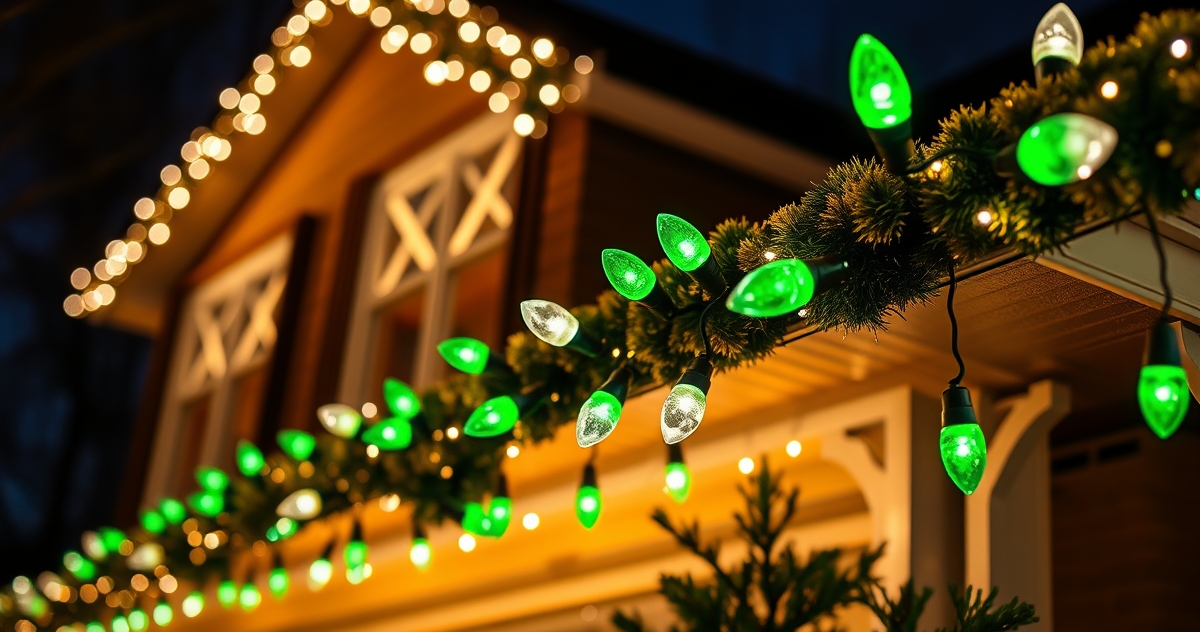
C9 bulbs — the large, faceted commercial-grade lamps measuring roughly 1.25 inches in diameter — are the workhorse of professional storefront displays for good reason. They produce significantly more lumens than mini lights, they are visible from across the street even in light snow, and their larger profile reads as intentional and high-quality rather than improvised. For Massachusetts storefronts, warm white C9 bulbs along rooflines, window headers, and door surrounds create a consistent, upscale glow that complements virtually every retail brand. Multicolor C9 strings work particularly well for restaurants, toy stores, and businesses targeting families, where a more festive, playful palette reinforces the brand experience. Read our full comparison of C7 vs. C9 Christmas lights to understand which size is right for your storefront's scale.
Garland: The Texture Layer That Makes a Façade Three-Dimensional
Commercial-grade garland — heavier, fuller, and UV-stabilized compared to residential product — adds the dimensional richness that separates a professional installation from a DIY one. On a Massachusetts storefront, consider these applications:
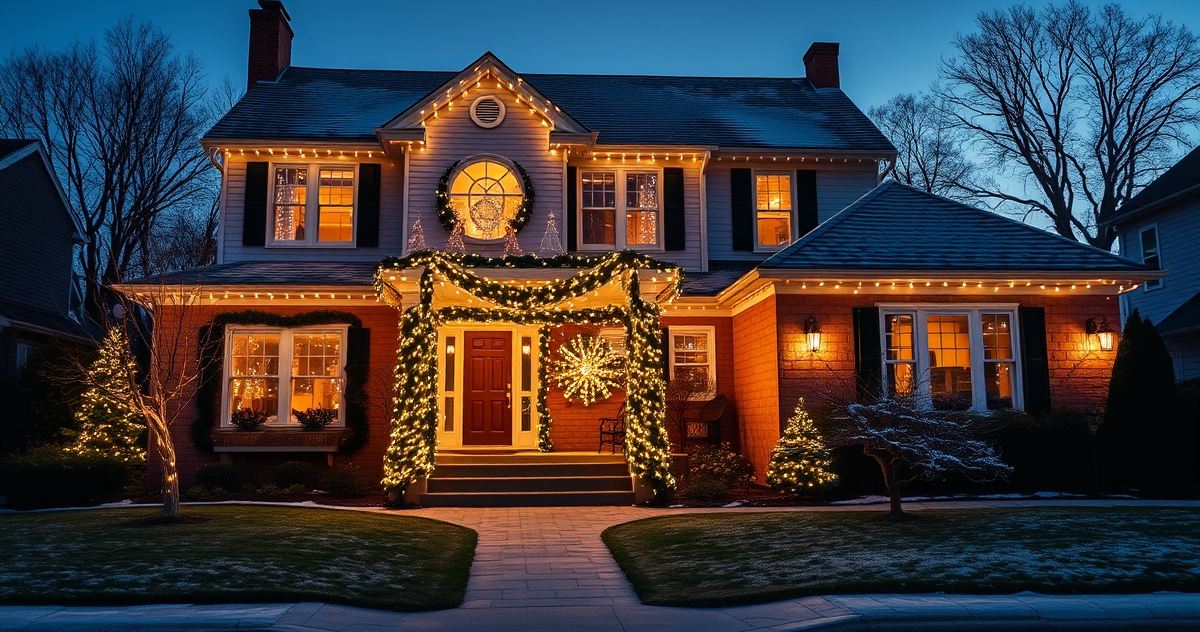
- Window framing: A 6-inch-diameter commercial garland draped in a gentle swag across the top of display windows, pinned with warm white C9 clips, frames your merchandise like a lit stage set.
- Door surrounds: Wrapping the door frame in garland with a pre-lit bow at the top creates an inviting threshold that is visible from 30 feet away on a dark December afternoon.
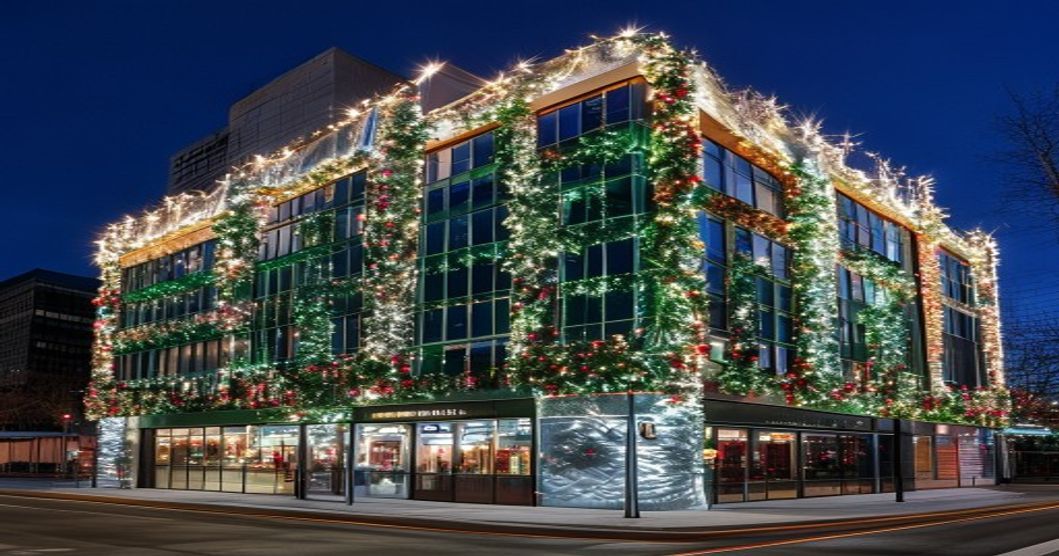
- Horizontal roofline runs: Long garland runs along the parapet or cornice, interwoven with C9 light strings, unify the entire façade and make the building look intentionally dressed rather than spot-decorated.
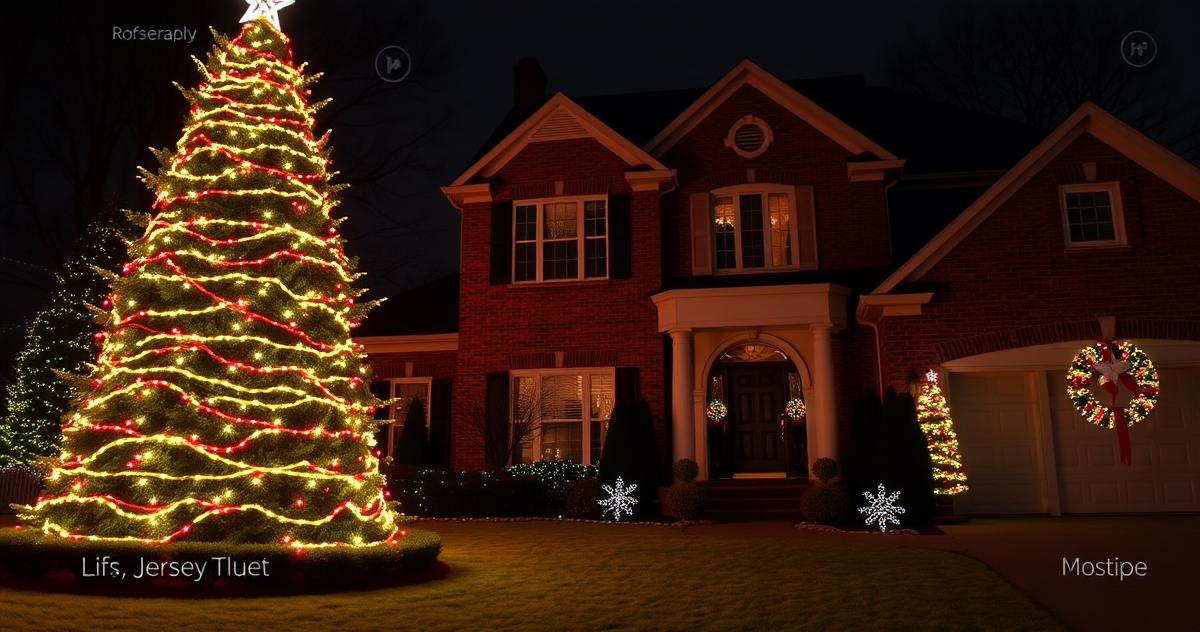
For properties with trees or planters along the sidewalk, combining garland with wrapped tree trunks creates a seamless display from ground to roofline. Our tree-wrapping installation guide for Massachusetts covers the technique in detail.
Wreaths as Anchor Points
Commercial wreaths — typically 24 to 36 inches in diameter for storefronts — serve as visual anchor points that give the eye a place to rest within a larger display. Position them symmetrically on upper-story windows, at either side of the entrance, or on any blank wall section that would otherwise read as empty. Pre-lit wreaths with warm white LED centers read cleanly from the street; add a velvet bow in red, gold, or your brand color to personalize without cluttering. For high-visibility locations, consider wreaths with built-in multicolor C9 accent bulbs around the perimeter for maximum impact after dark.
Color Strategy: Warm White vs. Multicolor
| Light Color | Best For | Mood / Brand Fit | Visibility in Snow/Fog |
|---|---|---|---|
| Warm White | Boutiques, restaurants, salons, banks | Elegant, upscale, timeless | Excellent — warm tone cuts through gray sky |
| Multicolor | Toy stores, family restaurants, entertainment venues | Festive, playful, high-energy | Very good — color contrast increases visibility |
| Cool White | Tech retailers, modern brand identities | Crisp, contemporary, minimal | Good in clear conditions |
| Brand Color Accent | Any business with strong brand identity | On-brand, memorable, ownable | Varies by hue — warm tones perform best |
Not sure which palette fits your storefront? Request a free design consultation and our team will mock up both options for your specific façade.
The Mid-Year Planning Checklist for Massachusetts Retail Storefronts
July through September is the ideal window to complete every planning task so that October and November are reserved for installation — not paperwork. Here is a month-by-month framework built for Massachusetts commercial clients.
July: Budget and Vendor Selection
- Set a total display budget including design, product, installation labor, permits, and removal/storage. For a typical Massachusetts Main Street storefront (roughly 30–50 linear feet of façade), expect professional commercial installation to range from $1,500 to $6,000+ depending on complexity. Get a detailed breakdown of commercial Christmas light costs.
- Research and contact at least two licensed, insured commercial holiday lighting companies in Massachusetts. Ask specifically about their commercial portfolio and references from retail clients.
- Confirm your vendor carries commercial-grade product (C9 bulbs, heavy-gauge SPT-1 or SPT-2 wire, commercial garland) — not residential product repurposed for a commercial job. Learn what commercial-grade Christmas lights actually means before signing any contract.
- Reach out to your landlord with a preliminary display description and request written consent. Booking in July can also mean real savings — read why early reservations benefit commercial clients.
August: Design Finalization and Permit Applications
- Finalize the display design with your chosen installer, including exact product specifications, power load calculations, and a scaled layout of the façade.
- Submit municipal permit applications. Allow four to eight weeks for processing in most Massachusetts communities.
- If your display includes any sidewalk elements, contact the local DPW or licensing board simultaneously.
- Sign your vendor contract. Confirm it includes an installation date, a removal date, product warranties, and liability coverage language.
September: Confirm and Prepare
- Confirm your installation date in writing. Most quality commercial installers in Massachusetts are fully booked by early October — do not wait.
- Receive and review your permit approvals. Flag any conditions or restrictions with your installer immediately.
- Plan your display launch date and any associated marketing (social media, email, press) so your team is ready to amplify the display the moment it goes live.
October–November: Installation Window
Professional installation of a commercial storefront display typically takes one to two days for a standard Massachusetts retail location. Your installer should handle all mounting, wiring, power management, and final testing. A quality commercial installation team will also provide a timer or smart-control setup so your display operates on a consistent schedule — typically dusk to 11 p.m. — without any staff involvement. For storefronts with significant tree or landscape elements, coordinate with professional tree lighting services to ensure both components are installed and lit before your launch date.
January: Removal and Storage
A professional holiday lighting contract should always include removal and storage — especially for commercial clients. January removal protects your display investment (commercial C9 strings and garland stored professionally can last five or more seasons), keeps your landlord happy, and ensures you are not paying staff overtime to wrestle frozen extension cords off a roofline. Ask your vendor about their removal and storage program and confirm it is written into your contract before October.
Why Commercial-Grade Product Matters More for Storefronts Than Anywhere Else
Massachusetts winters are not gentle. From nor'easters in November to ice storms in January, your storefront display will face conditions that destroy residential-grade product within weeks. Commercial-grade C9 bulbs are rated for outdoor use at temperatures as low as -40°F, use heavier-gauge wire with weather-sealed sockets, and carry a lamp life of 3,000 hours or more. Commercial garland is constructed with UV-stabilized PVC tips that hold their color and shape through multiple seasons of freeze-thaw cycling. Investing in proper product is not a luxury — it is the difference between a display that looks great on December 1st and still looks great on December 31st.
Find out why commercial-grade Christmas lights are worth the investment for any Massachusetts business that cares about appearance and uptime. For businesses considering a longer-term solution, permanent light systems offer year-round versatility — holiday displays in winter, brand-color accents in summer — with installation that pays for itself over three to five seasons.
Working With a Professional Installer vs. DIY: The Real Cost Comparison
Many Massachusetts storefront owners initially consider handling holiday lighting in-house to save money. Here is an honest look at what that calculation actually involves:
- Staff time: A typical storefront installation requires 8–16 hours of skilled labor. At $25–$40/hour fully loaded, that is $200–$640 in labor alone — before product cost.
- Equipment: Commercial ladders, lift equipment for taller facades, and proper electrical tools represent significant expense or rental cost.
- Liability: If a staff member is injured on a ladder or causes an electrical issue, your business insurance may not cover it. Professional installers carry their own workers' comp and general liability coverage.
- Quality: Professional installers know how to achieve the tight, uniform spacing and clean wire management that makes a display look intentional. Read how professionals achieve that polished look — and why it matters for customer perception.
For most Massachusetts retail storefronts, professional installation is not just more convenient — it is the smarter financial decision when you account for all real costs. Understand the true cost drivers of commercial holiday lighting before making your decision.
Frequently Asked Questions
Do Massachusetts storefronts always need a permit for holiday lights?
Not always, but more often than business owners expect. Whether you need a permit depends on your municipality, your display's electrical setup, and whether any elements extend over public property. In general, displays that plug into existing exterior outlets and stay within the building envelope are less likely to require a permit than those requiring new electrical work or overhead sidewalk elements. Boston, Worcester, Cambridge, and most historic downtown districts have stricter requirements than suburban commercial zones. The safest approach is to contact your local building department and the property manager in July — well before your installation date — to confirm what is required for your specific address.
How far in advance should a Massachusetts storefront book a commercial holiday lighting installer?
Quality commercial holiday lighting installers in Massachusetts are typically fully booked for October and November installations by mid-September, and the best firms often fill their commercial calendar even earlier. Booking in July or August gives you the widest choice of installers, the most design flexibility, and in many cases the opportunity to lock in early-booking pricing. Waiting until October means you may be limited to whoever has last-minute availability — which is rarely the installer whose work you admired on a competitor's storefront.
What is a realistic budget for commercial holiday light installation on a Massachusetts storefront?
For a standard Massachusetts Main Street retail storefront — roughly 30 to 50 linear feet of façade — a professionally designed and installed display using commercial C9 bulbs, garland, and wreaths typically ranges from $1,500 to $6,000 for the first season, including product, labor, permits, and removal. Larger footprints, multi-story buildings, or displays with custom elements will cost more. Many commercial clients find that costs decrease in subsequent seasons because product is already owned and stored — so the recurring annual cost may be 40 to 60 percent of the initial investment. A free site consultation will give you a precise estimate for your specific location.
Can my storefront use the same lights year after year?
Yes — commercial-grade C9 bulbs, garland, and wreaths are built to last multiple seasons when properly installed, removed, and stored. This is a key advantage of professional installation with a removal-and-storage contract: your product is carefully taken down, inspected, repaired if needed, and stored in a climate-controlled environment until the following season. Most commercial installations using quality product are designed with a five-season lifespan in mind, making the per-season cost significantly lower than it appears in the first year.
What is the difference between commercial-grade and residential holiday lights?
Commercial-grade holiday lights use heavier-gauge wire (typically 18 AWG or thicker), weather-sealed sockets rated for prolonged outdoor exposure, and bulbs with longer rated lamp lives (often 3,000 hours or more vs. 1,000 for residential product). Commercial garland is constructed with denser, UV-stabilized PVC tips that maintain color and shape through repeated freeze-thaw cycles. For a Massachusetts storefront that runs its display 6–8 hours per night for 60 days, the higher initial cost of commercial product pays off immediately in reduced replacements and consistent appearance throughout the season.
Does Holiday Lights Decor Massachusetts handle both installation and removal for commercial clients?
Yes. Our commercial contracts include full-service installation, professional removal, and secure off-season storage as a bundled offering for Massachusetts storefront clients. We handle all hardware, provide certificates of insurance for landlord approval, manage any required permits, and return the following season ready to reinstall your display — often with design updates you request during the off-season. Contact us for a free commercial site assessment and a detailed proposal for your storefront.
Ready to make your Massachusetts storefront the most eye-catching display on the block this December? Request your free commercial holiday lighting estimate today — our July calendar is open and our design team is ready to start planning your display now, so you can shine when it counts.